
Class 7 Grammar Worksheet on Comparing Ideas

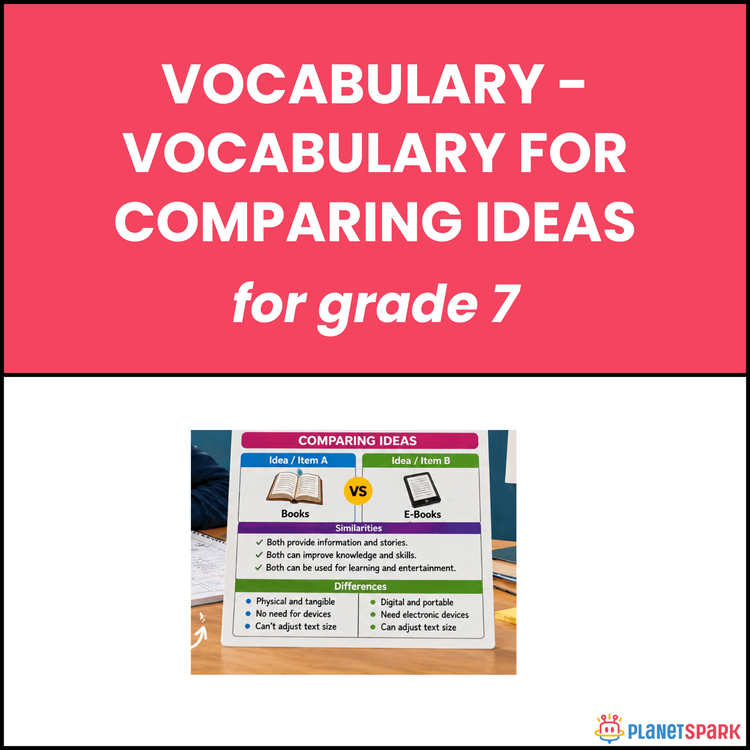
Class 7 Grammar Worksheet on Comparing Ideas
Mirror Images: Vocabulary for Comparing Ideas for Grade 7
This comprehensive Grade 7 worksheet focuses on "Vocabulary for Comparing Ideas," helping students identify and use words that highlight similarities between people, places, and concepts. Through diverse task types—including True or False logic puzzles, sorting word pairs, fill-in-the-blank sentences, multiple-choice questions, and a sentence rewriting challenge—learners master connectors like similarly, likewise, both, and comparable. This resource is designed to move students beyond basic descriptions, building their ability to construct logical comparisons in academic essays and everyday conversation. By distinguishing between comparison words and homophone traps, students sharpen their grammatical precision and reading comprehension in an age-appropriate, engaging format.
Book a free trial!
Why Vocabulary for Comparing Ideas Matters in Grammar?
For Grade 7 students, mastering comparison vocabulary is essential because:
1. It allows for the logical connection of similar ideas within complex sentences.
2. It helps students avoid repetitive language by providing a variety of synonym-based connectors.
3. Comparing ideas is a foundational skill for high school literature analysis and scientific reporting.
4. It encourages students to look beyond differences and find commonalities in their arguments.
Book a free trial!
What’s Inside This Worksheet?
This worksheet features five structured activities to build fluency in comparison:
🧠 Exercise 1 – True and False
Students evaluate statements about the function of specific connectors. Example: “Also connects similar ideas.”
📋 Exercise 2 – Sort the Word Pairs
Learners must separate legitimate comparison pairs (like near/close) from unrelated word pairs or homophones (like meat/meet).
✏️ Exercise 3 – Fill in the Blanks
Students choose the most appropriate word from a pair to logically complete a sentence. Example: “Riya and Raj are equally tall.”
🎯 Exercise 4 – Multiple Choice Questions
A test of accuracy where students select the best comparison word to fit the sentence context.
📝 Exercise 5 – Sentence Rewriting
Students are challenged to take sentences currently showing contrast and rewrite them using comparison words to show how the ideas are actually similar.
Book a free trial!
✅ Answer Key (For Parents & Educators)
Exercise 1 – True and False Exercise 2 – Sort the Word Pairs
1. False Comparing Ideas: near/close, similarly/like,
2. False like/same, also/too, both/each, fast/quick,
3. False hot/warm.
4. True Not Comparing Ideas: break/brake, feat/feet,
5. True both/pair, hour/our, knot/not, meat/meet.
6. True
7. False
8. True
9. False
10. True
Exercise 3 – Fill in the Blanks Exercise 4 – Multiple Choice Questions
1. Similarly 6. identical 1. b) similarly 6. b) like
2. likewise 7. effectively 2. b) likewise 7. b) also
3. equally 8. resembles 3. a) both 8. c) comparable
4. also 9. similarly 4. b) alike 9. d) equally
5. comparable 10. consistent 5. d) similar 10. c) same
Exercise 5 – Sentence Rewriting
1. The sun is bright; similarly, the stars are luminous.
2. Ravi likes to paint; likewise, his sister enjoys drawing.
3. Asha saw a deer; in the same way, she saw a fawn.
4. The boat is fast; similarly, the jet ski is quick.
5. I can hear the bell; also, I can hear the whistle.
6. The team is ready; likewise, the coach is prepared.
7. Ravi will buy a bat; in the same way, he will buy a ball.
8. The knight was bold; similarly, the king was brave.
9. The weather is hot today; likewise, it was warm yesterday.
10. Meera ate her food; also, Rohan finished his meal.
Help your child find common ground and write with logic by joining a Free 1:1 English Communication Trial Class at PlanetSpark.
🔖Book a free trial!
Frequently Asked Questions
These words show similarities between ideas clearly.
They organise essays and paragraph answers well.
Write daily comparisons of two people or things.